"Sirena con Hydria e Cupido" (Siren with Hydria and Cupid) Illustration

Side-by-side of my illustration and the original mosaic

Shaded version of the illustration
This opus vermiculatum mosaic from the Farnese Collection depicts a siren draped from her mid-torso, holding a hydria in her right hand and supporting what appears to be a platter (with an unidentified object) on her head with the other. She wears golden bracelets on both wrists and a necklace that rests around her collarbones. By her feet, a small bird (a dove?) flies with its wings outstretched. In the top right is a Cupid with anklets holding what is likely a thymiaterion with a 3-legged base and a rounded lid.
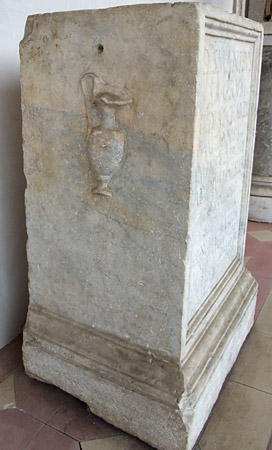
Greek hydriai have three handles: two horizontal ones on opposite sides below the shoulder and a longer vertical one (in between the former pair) connecting from the shoulder to the lip/neck. The one depicted in the mosaic appears to only have one handle and more closely resembles a (Roman style) pitcher/urceus (examples: 1, 2, 3)
The Sirens, daughters of the river god Achelous and one of the Muses, are described as young women/maidens with the plumage and feet of birds.
Quotes on the sirens (in original Latin + Greek):
“[...] vobis, Acheloides, unde pluma pedesque avium, cum virginis ora geratis? [...] facilesque deos habuistis et artus vidistis vestros subitis flavescere pennis. Ne tamen ille canor mulcendas natus ad aures tantaque dos oris linguae deperderet usum, virginei vultus et vox humana remansit.” (Ovid, Metamorphoses, 5.552-562)
“ἄλλοι γε μὴν ποικίλοι καὶ οὐ πάνυ τι τὸ εἶδος εὔρητοι, μελῳδίαν δὲ καὶ εὐστομίαν καὶ εὐγλωττίαν ἄμαχοι, ὡς εἶναι, εἰ μή πη καὶ τραχύτερόν ἐστιν εἰπεῖν, Σειρῆνάς τινας. κατάπτεροι γὰρ ὡς ἦσαν αἱ τοῦ μύθου κόραι, ποιηταί τε ᾄδουσιν καὶ ζωγράφοι δεικνύουσιν.” (Aelian, De Natura Animalium, 17.23)
“αἱ δὲ Σειρῆνες ἦσαν Ἀχελῴου καὶ Μελπομένης μιᾶς τῶν Μουσῶν θυγατέρες, Πεισινόη Ἀγλαόπη Θελξιέπεια. τούτων ἡ μὲν ἐκιθάριζεν, ἡ δὲ ᾖδεν, ἡ δὲ ηὔλει, καὶ διὰ τούτων ἔπειθον καταμένειν τοὺς παραπλέοντας. εἶχον δὲ ἀπὸ τῶν μηρῶν ὀρνίθων μορφάς.” (Apollodorus, Epitome, 7.18-19)
This Siren as a hydrophoros (“water-bearer”; or some other type of -phoros…) seems to reinforce her connection to the water whilst transforming her into a quotidian figure of religious or domestic ritual.
Thymiateria or thuribula (incense burners/censers used for religious worship) could be made of ceramics (1, 2, 3), metals (1, 2, 3), or stone (1, 2). Given that Cupid is holding the thymiaterion and that a dove-like bird is present, it should be noted that burning incense was also often associated with Aphrodite. Perhaps the subjects are taking part in a ritual dedicated to the goddess of love?
(Other possibly relevant images: 1, 2, 3)
Sources:
Bachvarova, Mary R. “Methodology and Methods of Borrowing in Comparative Greek and Near Eastern Religion: The Case of Incense-Burning.” The Intellectual Heritage of the Ancient Near East: Proceedings of the 64th Rencontre Assyriologique International and the 12th Melammu Symposium, University of Innsbruck, July 16‒20, 2018, edited by ROBERT ROLLINGER et al., Austrian Academy of Sciences Press, 2023, pp. 175–90. JSTOR, https://doi.org/10.2307/jj.3508406.11.
Gaifman, Milette. “The Incense Burner in Greek Art of the Fifth Century BCE” in: Holy Smoke: Censers Across Cultures, Beate Fricke Ed., (Munich: Hirmer, 2023), 109-127.
Géczi, János. "The rose in ancient Greek culture." Practice and Theory in Systems of Education 1, no. 1 (2006): 1-83.
Marcovich, Miroslav. “From Ishtar to Aphrodite.” Journal of Aesthetic Education, vol. 30, no. 2, 1996, pp. 43–59. JSTOR, https://doi.org/10.2307/3333191.
Zaccagnino, Cristiana. Il thymiaterion nel mondo greco: analisi delle fonti, tipologia, impieghi. Italy, "L'Erma" di Bretschneider, 1998.


.jpg)
